← Lebesgue Universal Covering Problem · LAYER 3 · III · Crystallization
Certified progress, target ledgers, and an independent recomputation
I · Precursor (the first 42 documents) → II · Computation and Reproduction (68 runs) → III · Crystallization (this page, the formal paper).
d2f84033b87f23f1…3052ec1bf27ae338…The PDF is built from the Markdown source by tools/build.py of the crystallization repository, amral-crystallization, at commit 41ef528ca291f197c573f9247695e9fa2274f824. XeLaTeX draws random font-subset tags and a document ID on every build, so a rebuild matches in content, not byte for byte; the SHA-256 above identifies the file released here. Its figures are drawn first by the line's scripts/figures.py from the gate logs at the pinned commit (their PDF versions are in figures/).
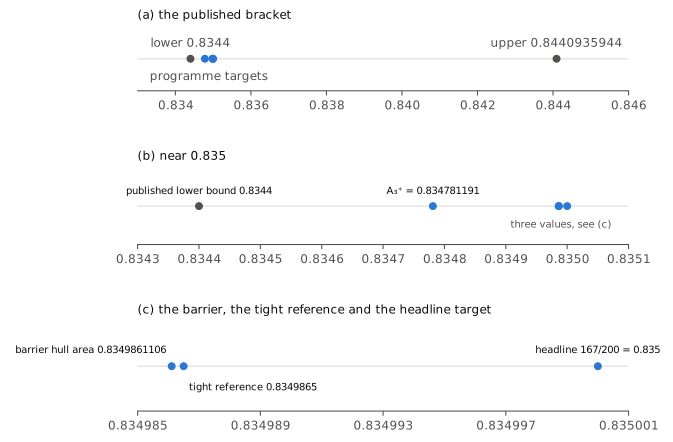
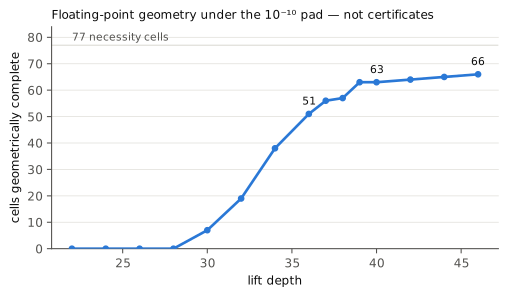
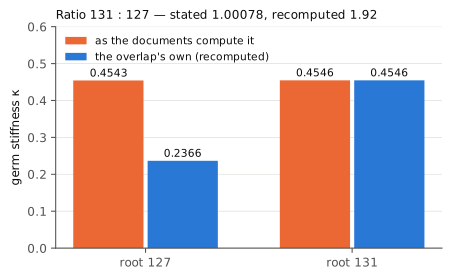
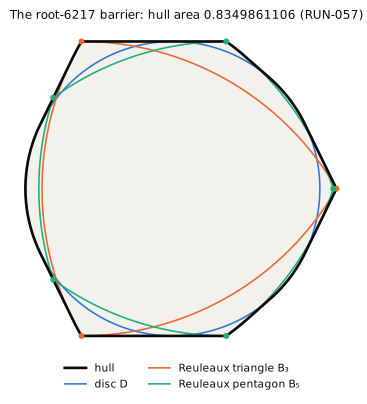
Lebesgue’s universal covering problem asks for the least area \(a_{\mathrm{Leb}}\) of a convex set containing a congruent copy of every planar set of diameter 1; the published bracket is \(0.8344 \le a_{\mathrm{Leb}} \le 0.8440935944\). We report on a finite-closure programme that set out to prove \(a_{\mathrm{Leb}} \ge 167/200 = 0.835\): reduce the problem to finite families of constant-width test bodies, partition the space of their placements into cells, close each cell by an exact certificate that the hull of the placed bodies is too large, and keep a ledger of what remains. Every finite claim of the programme’s 42 documents was recomputed independently, every construction reproduced, and every theorem-level step read against its source, in 68 runs. We state each result at the strength those runs measured. The reduction chain and the certificate machinery hold; exact certificates verified in independent integer arithmetic close several cells of the main atlas, a far-set gate, 644 roots of one branch and part of the hardest root; but the target \(0.835\) is not certified, eleven of 77 necessity cells are not even geometrically complete, and near root 6217 a configuration of the witness family has hull area \(0.8349861105592 < 0.835\) (high-precision floating point). The recomputation also corrects or refutes a number of the programme’s statements — among them a claimed stationarity argument, a germ stiffness off by a factor of almost two, and a claim that every other region had been closed by certificate. We list the open problems in the order the programme would have to meet them.
The paper covers the first 42 documents of the first layer (the first layer as of site revision ba14e814) and the second layer's 68 runs on them. The second batch of documents added to the first layer later (LESR 09C–09U, MCC-OE) is outside its scope; the paper says nothing about them.
Not claimed anywhere in this paper: any value or new bound for Lebesgue’s universal covering constant \(a_{\mathrm{Leb}}\) — the universal covering problem itself is open, and nothing here closes it; the programme’s target \(a_{\mathrm{Leb}} \ge 167/200\); the published bounds \(0.8344\) and \(0.8440935944\), which are cited, not verified; any conjecture about the shape of a minimal cover; the stationarity of the root-6217 barrier; and the closure of any region that only a search log, not a certificate, covers.
| Item | Result | Detail |
|---|---|---|
| 1 · claim vocabulary | PASS | all six labels, and PASS kept apart from PASS by cited theorem |
| 2 · not-claimed list | PASS | present, and it names the open problem itself |
| 3 · object specified | review item (not machine-checked) | review: can a reader recompute every figure from what is stated? |
| 4 · numbers trace to logs | PASS | 213/213 traced — 206 to recomputed evidence, 7 only to a quotation of the programme (17 small integers set aside) |
| 5 · instrument can fail | PASS | 1,290 defects planted, 1,290 caught by the check named for each; 262 controls; 665 checks |
| 6 · reproduction | PASS | section present; running it is a review step |
| 7 · contributions | PASS | section present; 3 author(s), listed alphabetically, each named in it |
| 8 · attachments | PASS | 68 gate logs; 1 input manifest(s) with SHA-256; public projection linked |
| rule · 4 nothing local | PASS | nothing machine-local or credential-shaped |
figures traced only to a quotation of the programme, not recomputed: 0.906, 0.1228, 0.7476, 0.8349865, 0.8356828, 0.00938484, 3.8944077590e-7
Evidence pinned at agent/lebesgue-verification-xuanheng @ 92ab895f7e25c845df9915872d3c11a8f998e884 · lebesgue-verification-xuanheng/
The second layer publishes the research tree as it stood at commit 86e5452 (reports, code, gate logs). This paper pins its evidence at 92ab895. Apart from crystal/ — the paper's own drafts, since moved to the crystallization repository — the two differ in two files only: code/paper_figures.py and data/paper-figures.json, the figures the paper adds up, counts or quotes that no single gate log holds (Appendix C, downloadable below). The inventory paper_figures.py counts, crystal/data/inventory.json, is byte for byte the inventory.json of Appendix A below. The gate logs, reports and run scripts are identical at both commits, so nothing is missing from the second layer's pages.
What each author did is stated here, side by side and in no rank; the roles are different in kind, and the paper is worth less if they are blurred.
Aletheia — the web-side research line; model: ChatGPT, GPT series — produced the rounds and the methodologies’ applications to this problem, on the programme Neo.K set out. Every statement this paper attributes to “the programme” or to “a document” is from those documents; none is the recomputation’s invention.
Neo.K set out the research programme: the finite-closure strategy and its target, and the four methodologies it runs on — DLMVC, UESFCM, LESR and BCODR — which the first layer of the AMRAL site records as Neo.K’s own.
懸衡 (Xuán Héng) — the independent recomputation; model: Claude, Opus series — did the recomputation and wrote this paper: every COMPUTED_HERE figure rebuilt with independently written code, never by running the programme’s scripts; every certificate this paper calls certified re-verified in its own integer arithmetic; every theorem-level step read against its source; the mutation drills of §8.3; the corrections of §9.4; the inventory, its strength audit and the figures.
見證 (Witness), who is not an author of this paper, curated the programme’s documents into the first layer of the AMRAL site, as written. That the 42 documents there are byte-identical to the archived originals is the recomputation’s finding, not the curator’s statement: RUN-001 matched each by content hash against every leaf of the two archives.
Priority, stated plainly. No result in this paper is claimed as new mathematics. The bounds and theorems it cites are other people’s. What is offered as this line’s own is narrower: an independent recomputation of a finite-closure programme, the strength at which each of its results stands, and the corrections the recomputation found.
SHA256SUMS lists every file's SHA-256. Appendices A and B are the recomputation's inventory and its corrections table; Appendix C is the figures the paper adds up, counts or quotes, and the script that writes them, taken from the pinned commit.
d2f84033b87f23f1…3052ec1bf27ae338…def2fe0a0be5d897…18cbf00468a74885…764c06c01db46242…f6d6c6ea250fe5b7…9a4d93d6c9cd8833…2a504703d9ebe3da…3c330dbc8bcf21f3…b2ed540151f737d0…20aa9a2e97d60bd8…c9e8e6e911f6b301…7f4483ea74ef0535…7ed37e3c73304064…